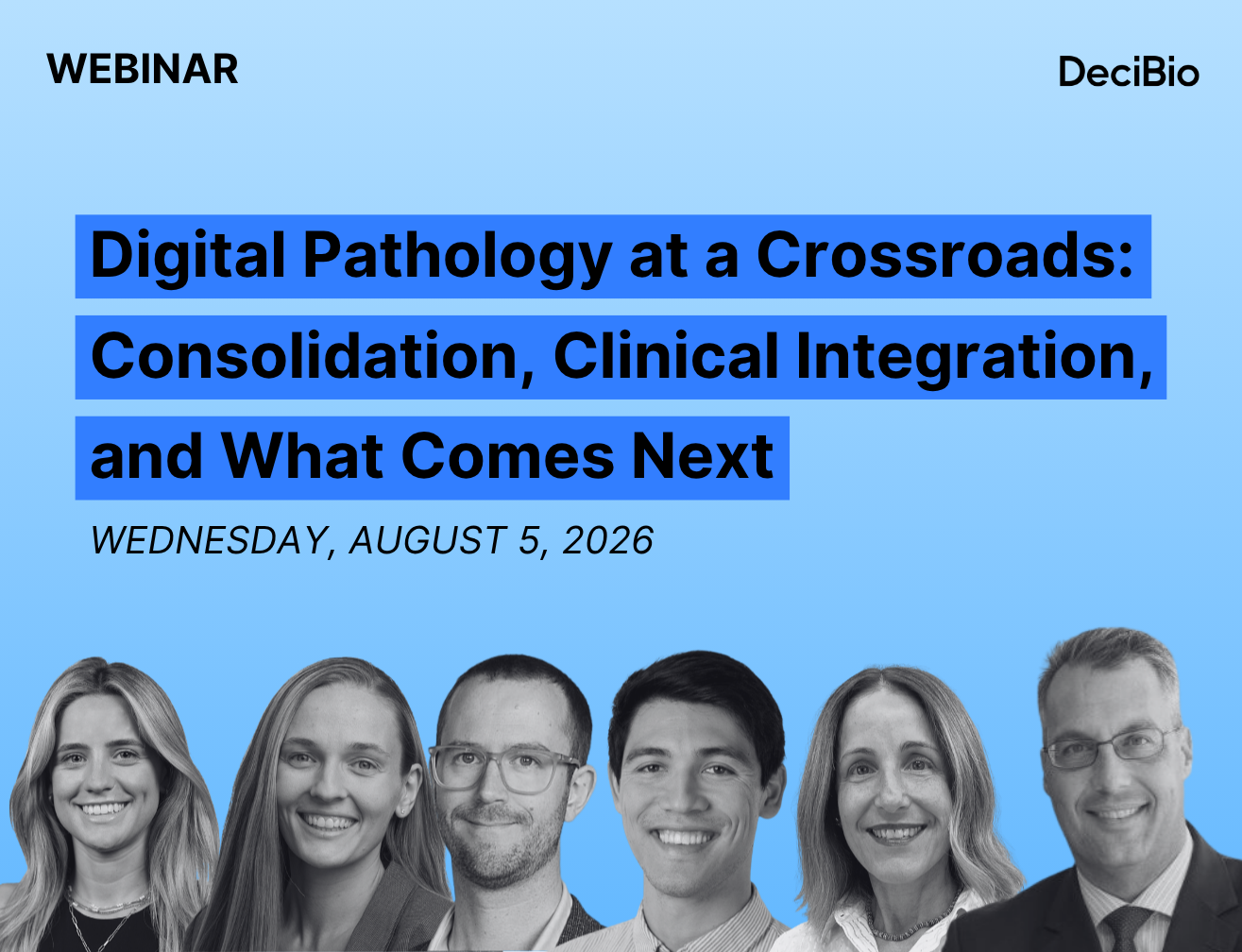


This webinar was recorded on Wednesday, August 5, 2026.
Key Insights from the Digital Pathology Webinar
Digital pathology is at an important transition point. Digitization continues to expand, consolidation is bringing greater scale and investment to the market, and computational pathology is opening new clinical possibilities. However, interoperability, reimbursement, and regulatory complexity remain major barriers to broader adoption.
Our recent webinar brought together experts across the digital pathology ecosystem to discuss what will determine the pace of adoption and how the field can move from promising technology to routine clinical use.
Consolidation and Interoperability: Building for Scale
Consolidation and partnerships are helping bring together the technology, infrastructure, and commercial reach needed for broader deployment. At the same time, panelists emphasized that scale will depend heavily on interoperability.
Ashley Easter noted that smaller algorithm developers need access to established image management systems and scanner networks, while larger vendors benefit when supporting a broad ecosystem with comprehensive apps available. Rather than closing off platforms, the goal is increasingly to make tools easier to deploy across different laboratory environments.
Regulation and Reimbursement: Persistent Barriers
Regulatory pathways are evolving, but digital pathology still faces significant complexity. Predetermined change control plans (PCCPs) were highlighted as meaningful progress, particularly for expanding algorithm labels, but they address only part of the validation burden. Nick Brown commented on their ability to streamline expansions for PathAI, but only to a certain extent.
Panelists discussed how clinical deployment still requires end-to-end validation across scanners, displays, software, and workflows. Reimbursement remains another major constraint, as laboratories must often justify multi-year investments across several budgets. Companion diagnostics and other revenue-generating applications could help strengthen that business case.
Clinical Utility: Moving Beyond Digitization
The conversation is increasingly shifting from whether pathology should be digitized to what digital pathology can enable clinically. Computational tools could influence biomarker assessment, patient selection, and treatment decisions, broadening the value proposition beyond workflow efficiency alone.
As adoption expands, the business case may also become less dependent on pathologists alone. Panelists note how pharma partners as well as oncologists increasingly stand to benefit from digital pathology as it becomes more closely tied to precision medicine.
Computational Pathology: From Potential to Practice
Foundation models and H&E-based prediction tools are expanding what can be derived from routine pathology images. These approaches could support new biomarkers, improve model robustness, and make it easier to develop additional applications on top of digital infrastructure.
Panelists emphasized that the benefits are unlikely to accrue only to the largest established players: both existing leaders and the broader market stand to gain as these tools mature. The key will be demonstrating reliable performance across institutions and showing that algorithms meaningfully improve diagnosis, treatment decisions, or patient outcomes.
Looking Ahead
Panelists expect continued growth in digital pathology utilization, more approved computational pathology tools, and deeper laboratory automation. The direction is increasingly clear: digital pathology is moving toward becoming standard infrastructure for precision medicine.
The open question is how quickly the industry can align interoperability, regulation, reimbursement, and clinical evidence to get there.
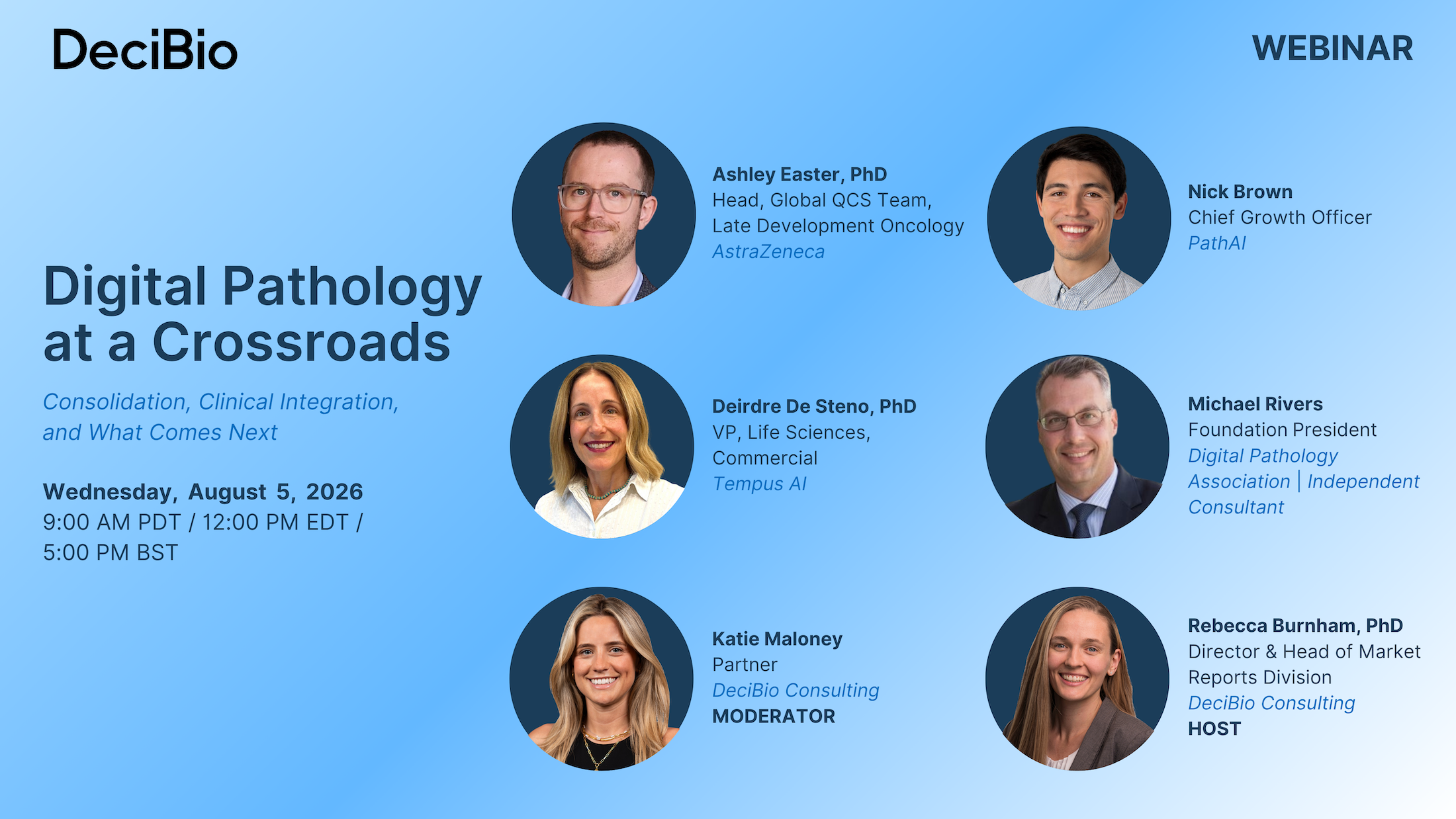
Speakers:
- Ashley Easter, PhD, Head, Global QCS Team, Late Development Oncology, AstraZeneca
- Deirdre De Steno, PhD, VP, Life Sciences, Commercial, Tempus AI
- Michael Rivers, Foundation President, Digital Pathology Association; Independent Consultant
- Nick Brown, Chief Growth Officer, PathAI
Moderators:
- Katie Maloney, Partner, DeciBio Consulting
- Rebecca Burnham, PhD, Director & Head of Market Reports Division, DeciBio Consulting
Check out the full webinar below to hear all the insights. Interested in learning more? Explore our Digital Pathology DxBook, and our recently published Digital & Computational Pathology Market Report.
Webinar Recording:

.png)